Gene regulation
Gene regulatory networks
I develop methods to reconstruct and explore regulatory relationships between transcription factors and their target genes, particularly from single-cell transcriptomics data.
Research and teaching
I am a computer scientist working in bioinformatics at the VIB-UGent Center for Plant Systems Biology. My research focuses on developing computational methods that help extract biological knowledge from large and complex datasets.
Most of my work lives somewhere between algorithms, genomes and gene regulation. The aim is not simply to generate more results—biology already provides plenty of those—but to make them interpretable, reproducible and useful.

Research interests
My projects combine software development, data integration and biological interpretation, with a particular interest in plants and diatoms.
Gene regulation
I develop methods to reconstruct and explore regulatory relationships between transcription factors and their target genes, particularly from single-cell transcriptomics data.
Single-cell biology
Single-cell datasets make it possible to study biological processes at cell-type resolution. They also create large, sparse and occasionally stubborn datasets that require carefully designed computational approaches.
Genomics
I work with short- and long-read sequencing data to assemble, evaluate and compare genomes, from plant-associated projects to non-model organisms with little interest in making the process easy.
Software
A substantial part of my work consists of turning scientific ideas into usable software: designing workflows, implementing methods, testing results and trying to make complex analyses reproducible.
Featured project
MINI-EX is a computational framework for reconstructing cell-type-specific gene regulatory networks from single-cell transcriptomics data. It integrates gene expression, transcription-factor binding information and network-based prioritisation to identify regulators associated with particular biological processes.
The project began with a deceptively simple question: can we move beyond describing which genes are expressed and start identifying the regulators that may be driving those expression programmes? Several versions, many datasets and quite a few debugging sessions later, the answer appears to be yes.
Visit the MINI-EX project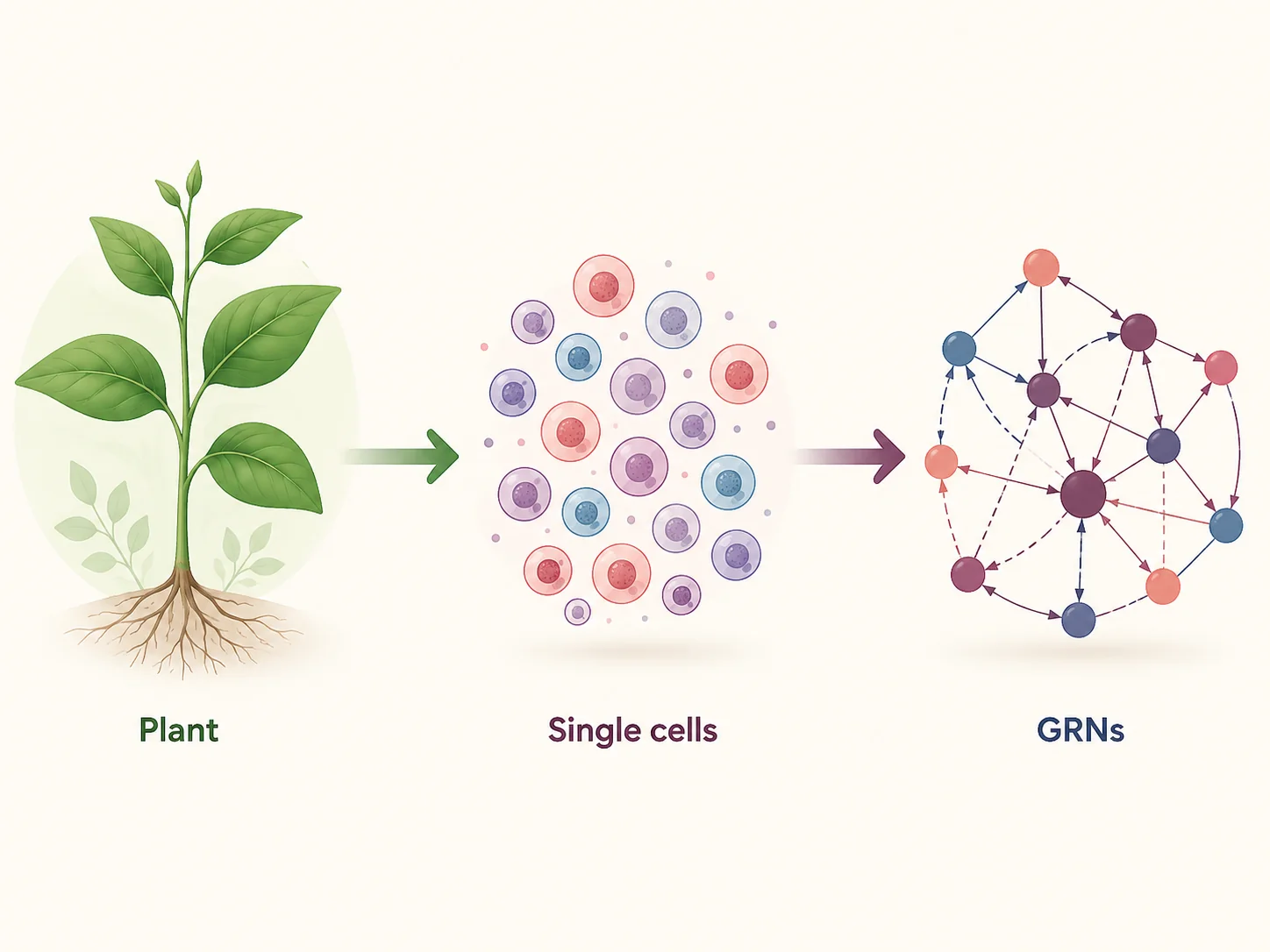
From methods to biology
Methods are most useful when they lead back to biology. I apply network inference and data-integration approaches to questions involving plant development, stress responses, cell identity and regeneration.
Recent work has included regulatory-network analysis of maize somatic embryogenesis, where computational predictions were used to prioritise candidate morphogenic regulators for experimental validation.
Teaching and supervision
Alongside research, I teach bioinformatics, Linux, programming and computational thinking. At Ghent University, I teach and supervise students in the Master of Science in Biochemistry and Biotechnology, particularly within the Bioinformatics and Systems Biology major, and I coordinate the Foundations module of the ULB/VUB's Executive Master in Digital and IT Essentials. This means that, depending on the day, I may be explaining shell commands, Python, algorithms or why a terminal is not actually trying to intimidate anyone.
Command-line fundamentals, text processing, shell scripting, HPC environments and reproducible computational work.
Supervision of interdisciplinary student projects combining biological questions, data analysis and software development.
Algorithms, Python, data structures and computational thinking for students from scientific and non-technical backgrounds.
Contributions to seminars and practical sessions in genomics, comparative genomics, single-cell analysis and scientific computing.
A slightly indirect route
My academic path started in computer science and software engineering before gradually moving towards genomics and evolutionary biology. That combination still shapes how I approach research: biological questions on one side, implementation details on the other.
Before working on plant regulatory networks, I studied genome evolution and introgression in closely related leaf-beetle species. The organisms and questions have changed, but the common thread remains the same: using computational methods to understand how biological systems work.
Find out more